✅ These resources are provided free by Smart Home America, Inc. Both versions supplement the International Residential Code (IRC). Any jurisdiction or municipality may adopt them.
Who Is This For?
The Construction Code Supplement is for anyone involved in building policy, code enforcement, or community resilience planning. It is especially useful if you are:
- A building official or code enforcement officer looking to strengthen local residential construction standards.
- A city council member, mayor, or county commissioner exploring ways to reduce storm damage and insurance costs for residents.
- A community planner or resilience coordinator developing a hazard mitigation or recovery plan.
- A builder or contractor working in a jurisdiction that has adopted or is considering the Supplement.
- A state agency or policy advocate promoting stronger residential building standards statewide.
Key Benefits of Adoption
Adopting the Construction Code Supplement bridges the gap between standard "I Codes®" and IBHS FORTIFIED Home™ Technical Standards. Communities that adopt the Supplement see:
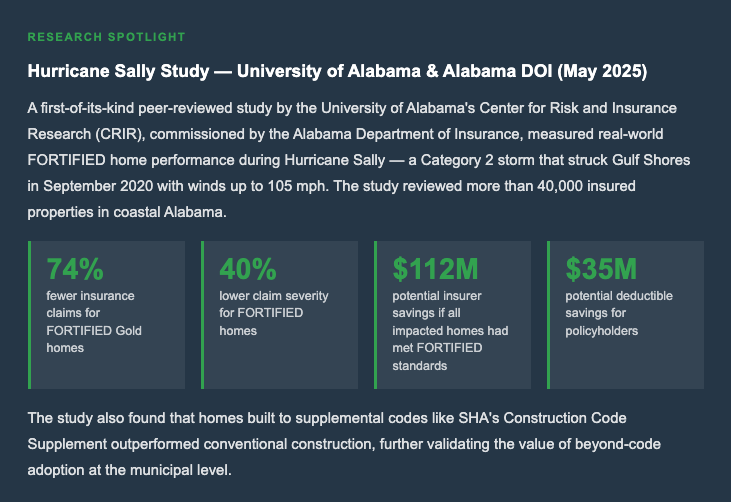
- Reduced storm damage - Homes built to higher standards experience less damage during hurricanes and severe weather.
- Lower insurance costs - Residents in these communities may qualify for reduced homeowner's insurance premiums.
- Increased property values - Research shows FORTIFIED-standard construction increases resale value.
- Reduced cleanup costs - Stronger homes create less storm debris, lowering cleanup costs for municipalities.
- FEMA cost-benefit alignment - Adoption satisfies FEMA P-804 requirements, eliminating the need for a separate benefit-cost analysis on qualifying wind retrofit projects.
- Flood resilience pathway - When used with IRC/IBC flood standards, it addresses both wind and flood hazards in one code framework.
Downloads
Two versions are available: one for coastal communities and one for inland communities. Both supplement the IRC and may be adopted alongside local building codes.
Coastal Communities
Inland Communities
Why the Code Supplement Exists
Community leaders and Building Code Officials in Coastal Alabama, partnering with Smart Home America, developed the idea after Hurricanes Ivan and Katrina. The Supplement uses FORTIFIED Home™ beyond-code recommendations to increase resilience and reduce future damage from hurricanes, high winds, hail, and wind-driven rain. It is based on the latest research and testing at the IBHS Research Center, with ongoing technical input from IBHS to keep it current.
Smart Home America also recommends adopting the IRC/IBC flood-resistant construction standards with this Supplement. Incorporating both wind and flood hazard mitigation increases the durability and safety of homes.
⚠ Important Note: Homes permitted under this Supplemental Code are built to beyond-code standards but will not automatically receive a FORTIFIED Home™ designation. To earn a Designation Certificate, a homeowner or builder must contract with a Certified FORTIFIED Evaluator™, the only professional authorized to inspect and certify that a home meets all IBHS FORTIFIED Home requirements.
Communities Leading the Way
Jurisdictions across the Gulf Coast region have adopted the Construction Code Supplement. These communities set a standard for resilient residential construction and see real results in reduced storm damage and insurance savings.
- Baldwin County, AL - Coastal Code Supplement adopted countywide. See examples of success.
- City of Foley, AL - Adopted as part of broader resilient housing initiative
Is your jurisdiction considering adoption? Contact us, and we can help guide you through the process.
Frequently Asked Questions
- Does adopting the Code Supplement replace our existing building code?
No. The Construction Code Supplement is adopted in addition to your existing local building codes, not as a replacement. It closes the gap between standard I Codes® and IBHS FORTIFIED Home™ Technical Standards by adding specific requirements for wind resistance beyond the code. - Does a home built under this code automatically become a FORTIFIED Home™?
No. Homes built under the Supplemental Code meet beyond-code standards, but they are not automatically designated as FORTIFIED Home™. To earn an official FORTIFIED Designation Certificate, a homeowner or builder must hire a Certified FORTIFIED Evaluator™ to inspect the home and confirm it meets all IBHS program requirements. - Who can adopt the Supplement?
Any municipality, city, county, or jurisdiction in the United States can adopt the Supplement. We assist communities with the adoption process and answer questions from building officials, elected officials, and planners. - Which version should our community download — Coastal or Inland?
The Coastal Code Supplement is for communities in coastal areas that face hurricane and tropical storm risk. The Inland Code Supplement is for communities further from the coast that still face severe wind, hail, and storm risks. If you are unsure which applies to your community, contact us for guidance. - Can our community modify the Supplement before adopting it?
Yes, jurisdictions and municipalities may modify the Supplement to fit local needs. We encourage communities with questions about modifications or the adoption process to contact us at 1-855-742-7233 or info@smarthomeamerica.org. - How does this relate to FEMA P-804?
Adopting the Code Supplement aligns local building code with FEMA's P-804 Wind Retrofit Guide for Residential Buildings. Qualifying hurricane wind retrofit projects built to these standards are exempt from a separate benefit-cost analysis, saving time and resources for communities seeking FEMA mitigation funding.
FEMA P-804 & FORTIFIED
Adopting the Code Supplement aligns local building code with FEMA's P-804, Wind Retrofit Guide for Residential Buildings. FEMA's Job Aid sets predetermined benefits to show the cost-effectiveness of wind retrofit projects. Building to these standards removes the need for a separate benefit-cost analysis for qualifying hurricane wind retrofit projects.
- FEMA P-804: Wind Retrofit Guide for Residential Buildings
- FEMA P-804 Job Aid (Cost-Effectiveness Analysis)
- How P-804 Aligns with IBHS FORTIFIED Standards (SHA Brief)
Related Resources
- FORTIFIED Construction FAQs
- Model Building Codes
- Examples of Success — Communities That Have Adopted
- The Effect of FORTIFIED Construction on Home Resale Value
- FORTIFIED Policy FAQs
- Resilient Housing Planning Guide
Have Questions?
Whether you're considering adoption, have questions about modifying the Supplement, or want to learn more, we can help.